One of the key features of the Sheeran Looper+ is the ability to preload audio files for use as backing tracks and live performances. However, before audio files can be imported, the required loop structure must first be created on the hardware.
TABLE OF CONTENTS
Before Importing Audio Files
Before WAV files can be imported, a loop must first be created and saved on the Looper+.
- Select the loop mode you intend to use (Single, Multi, Song, or Sync).
- Record a short loop on the Looper+.
- Save that loop to a slot.
The folder structure created within a slot depends on the loop mode that was selected when the loop was created and saved.
For example:
- Single Mode creates a structure suitable for a single loop.
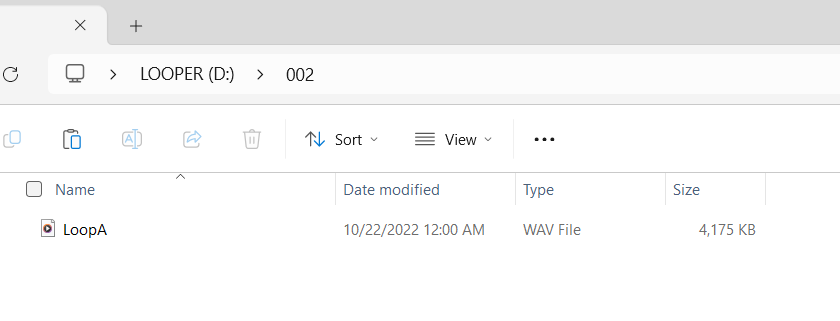
- Multi Mode creates Multi_A and Multi_B folders.
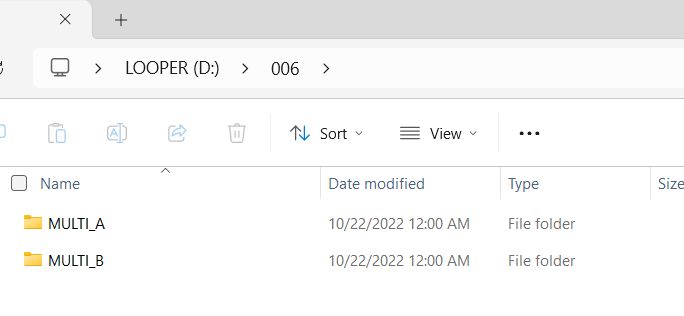
- Song Mode and Sync Mode create structures appropriate for those modes.
This step is required because the Looper+ uses the saved loop to create the correct internal folder structure for that slot.
Entering USB Mode
To access the Looper+'s internal storage:
- Connect the Looper+ to your computer using a USB cable.
- Power on the Looper+ and wait for it to finish booting.
- Press and hold the main encoder knob to enter the menu.
- Navigate to USB and press the encoder.
- Select START.
- The display will briefly show SETUP... while the connection is established.
- The Looper+ will appear on your computer as a removable drive named LOOPER.
Importing Audio Files
Once the slot structure has been created:
- Enter USB mode.
- Open the saved slot folder.
- Copy your converted WAV files into the appropriate location within the folder structure created for that mode.
- Safely eject the LOOPER drive from your computer.
- On the Looper+, press the encoder while Exit and Restart is displayed.
- The Looper+ will restart and return to normal operation.
Notes
- Supported import format: Stereo WAV
- Unsupported files will be ignored.
- Always safely eject the LOOPER drive before exiting USB mode.
- Loops that are incorrectly trimmed or use unusual bar lengths may not behave as expected when used with MIDI synchronisation or advanced loop modes.
Was this article helpful?
That’s Great!
Thank you for your feedback
Sorry! We couldn't be helpful
Thank you for your feedback
Feedback sent
We appreciate your effort and will try to fix the article